
Research
Research Philosophy
Dr. Flemming views research as both a process of discovery and a pathway for connection. Her work integrates biodiversity science, museum collections, and education to better understand the natural world while creating opportunities for others to participate in scientific inquiry. She believes research has its greatest impact when it not only advances knowledge but also invites curiosity, broadens participation, and strengthens relationships between people, science, and the communities they serve.
Fieldwork and Collections
Fieldwork and natural history collections have been foundational to Dr. Flemming's development as both a scientist and educator.
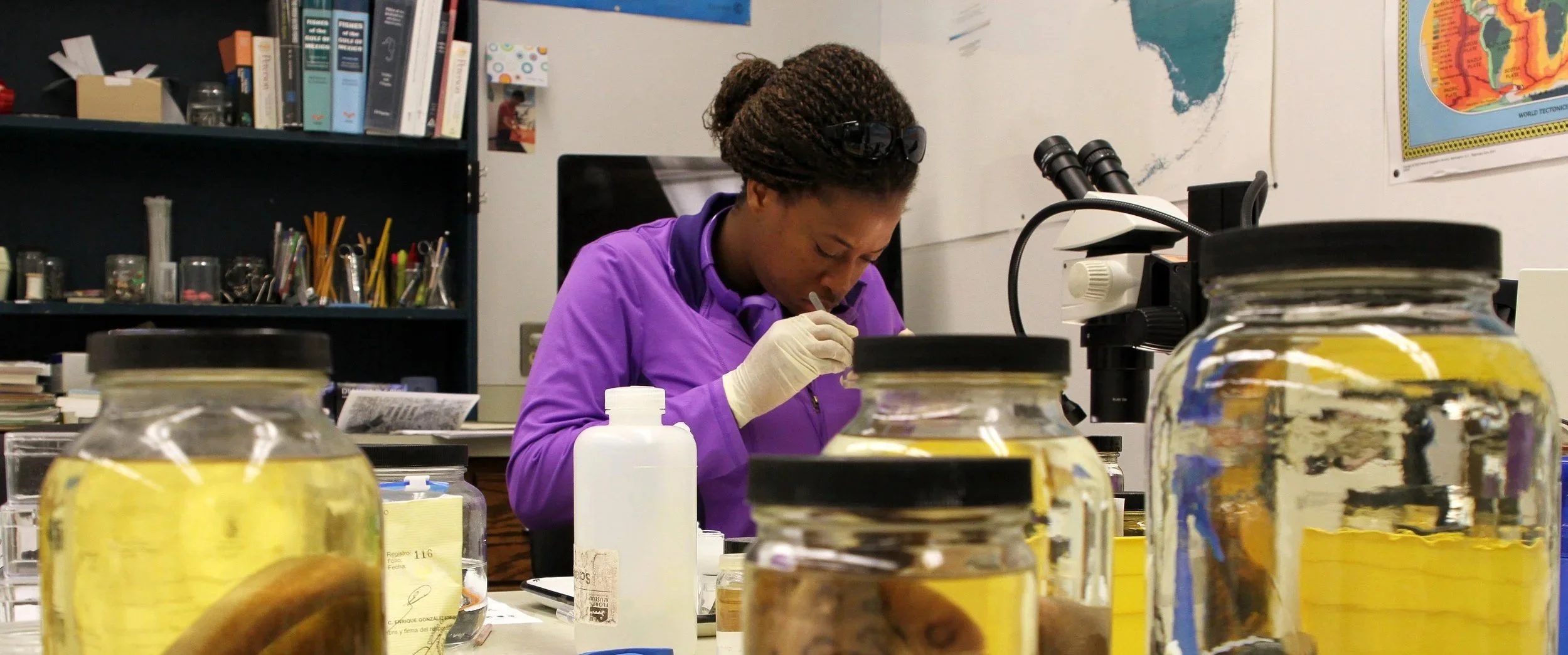
Throughout her career, she has conducted research across freshwater, marine, and estuarine systems using a variety of sampling techniques to investigate biodiversity, ecology, and species distributions. Her experience includes specimen collection, identification, tissue sampling, DNA preservation, mark-recapture studies, and biodiversity documentation for both research and conservation.
Her collections experience includes specimen preparation, curation, databasing, collections management, and long-term preservation of scientific specimens. These collections serve as invaluable records of biodiversity and provide opportunities for research, education, conservation, and public engagement.
Equally important is her commitment to helping others access these experiences. Throughout her career, Dr. Flemming has mentored students from middle school through graduate school in field research, museum collections, and biodiversity science. She believes fieldwork and collections-based learning can be transformative experiences that build scientific skills, confidence, and lasting connections to the natural world.
As an educator and mentor, she is particularly interested in creating field experiences that are both meaningful and safe. This commitment led her to develop a field safety guide for students participating in research and field-based learning, providing practical tools that help individuals approach fieldwork with preparation, confidence, and care for themselves and their communities.
Research Areas
-
Dr. Flemming's research explores the ecology, life history, systematics, diversity, and distribution of freshwater fishes, particularly in the southeastern United States. Her work combines field research, museum collections, and specimen-based analyses, including studies of the Swamp Darter (Etheostoma fusiforme) and Bayou Topminnow (Fundulus nottii).
-
Dr. Flemming's scientific training spans marine biology, ichthyology, invertebrate zoology, collections-based science, and biodiversity research. Her work examines biodiversity through research, conservation, education, and public engagement, with particular attention to the relationships among people, place, and the natural world.
-
Discovering natural history museums transformed Dr. Flemming's understanding of what science could be. Prior to graduate school, she was unaware that careers in museums existed. Working across multiple collections at the Florida Museum of Natural History introduced her to the critical role collections play in research, conservation, education, and storytelling. Her experience includes specimen preparation, curation, databasing, field collecting, collections management, and research. Equally important, she is committed to helping others discover museums as spaces of curiosity, learning, and possibility.
-
Dr. Flemming's education research explores how experiential learning, mentorship, and authentic scientific practice shape scientific identity and broaden participation in STEM. This work emerged through the development of Introduction to Natural History, a course designed to connect undergraduate students with museum collections, mentorship, and scientific inquiry. More broadly, she investigates how educational experiences can foster belonging, confidence, and long-term participation in science.
Selected Publications
Krumm, J. L., Jordan, C. N., Bronson, C. D., Weglarz, K. M., Genet, K., Johnson, M. G., Phillips, M., Flemming, A., & Woods, J. (2024). Improving access to undergraduate research using digitized natural history collections course‐based research experiences. Ecosphere, 15(11), e70038.https://doi.org/10.1002/ecs2.70038
Consuegra, V., Flemming, A., & Claunch, N. (2024). Relationship between predation and maternal investment In Curly-Tailed Lizards. Reptiles & Amphibians, 31(1), e22640.https://doi.org/10.17161/randa.v31i1.22640
Flemming, A (2023). Student‐focused, career‐driven exploration in natural history museums through experiential education and mentorship: A model to intentionally increase the racial and ethnic diversity of students. Natural Sciences Education, 52(1), e20097.
Flemming, A., & Page, L. M. (2020). Life History of the Swamp Darter, Etheostoma fusiforme, in Florida. Southeastern Naturalist, 19(2), 418-435.
Flemming, A., et al. (2020). Using Digital Natural History Collections in K-12 STEM Education. Journal of Museum Education, 45(4), 450-461
Selected Open Education Resources
Mabry, M.; Flemming, A.; Phillips, M.; Zeringue-Krosnick, S. E.; Kovacs, J.; Leachman, S. (2024). Introduction to Bionomia. BCEENET- Biological Collections in Ecology & Evolution Network, QUBES Educational Resources. doi:10.25334/AXVE-E198
Leachman, S.; Flemming, A., Mabry, M., Phillips, M., Zeringue-Krosnick, S. E., Kovacs, J., & Aina, O. (2023). An Introduction to Revealing Hidden Figures through Data Sleuthing. doi:10.25334/2JTC-C713
C. Early, Flemming, A., Pirlo, J., Ruiz-Escobar, S. (2021). Thinking About Graduate School in Biology: Our Tips for Success. iDigBio, QUBES Educational Resources. doi:10.25334/QKVY-DS19
Selected NSF-Supported Projects
RCN-UBE: Broadening Undergraduate Participation in Ecology and Evolution Research through CUREs Using Digitized Natural History Collections Data
NSF Award #2120063 | $499,811
Role: Proposal Contributor & Editor | 2021–2027RAPID: Development of Online-Based Research Experiences to Mitigate the Negative Impacts of the COVID-19 Pandemic on Undergraduate Biology Education
NSF Award #2032158 | $198,979
Role: Steering Committee Member; Proposal Contributor & Editor | 2020–2022RCN-UBE Incubator: Network for the Integration of Natural History Collections in Ecology and Evolutionary Biology Course-Based Undergraduate Research Experiences
NSF Award #1920385 | $74,494
Role: BCEENET Steering Committee Member | 2019–2022
More than $51,000 awarded through individual competitive fellowships, scholarships, grants, and awards.
SEC Emerging Scholar Award, $14,500
UF CLAS Dissertation Fellowship, $8000
McKnight Dissertation Fellowship — $7,000
UF Grinter Fellowship, $6000
Madelyn Lockhart Dissertation Fellowship, $1000
Selected Fellowships & Awards